 7132 178 St NW,

 Call us:



 Call us780-809-1056
- Mail usinfo@inspecus.ca
- Schedule An Inspection
Call us780-809-1056

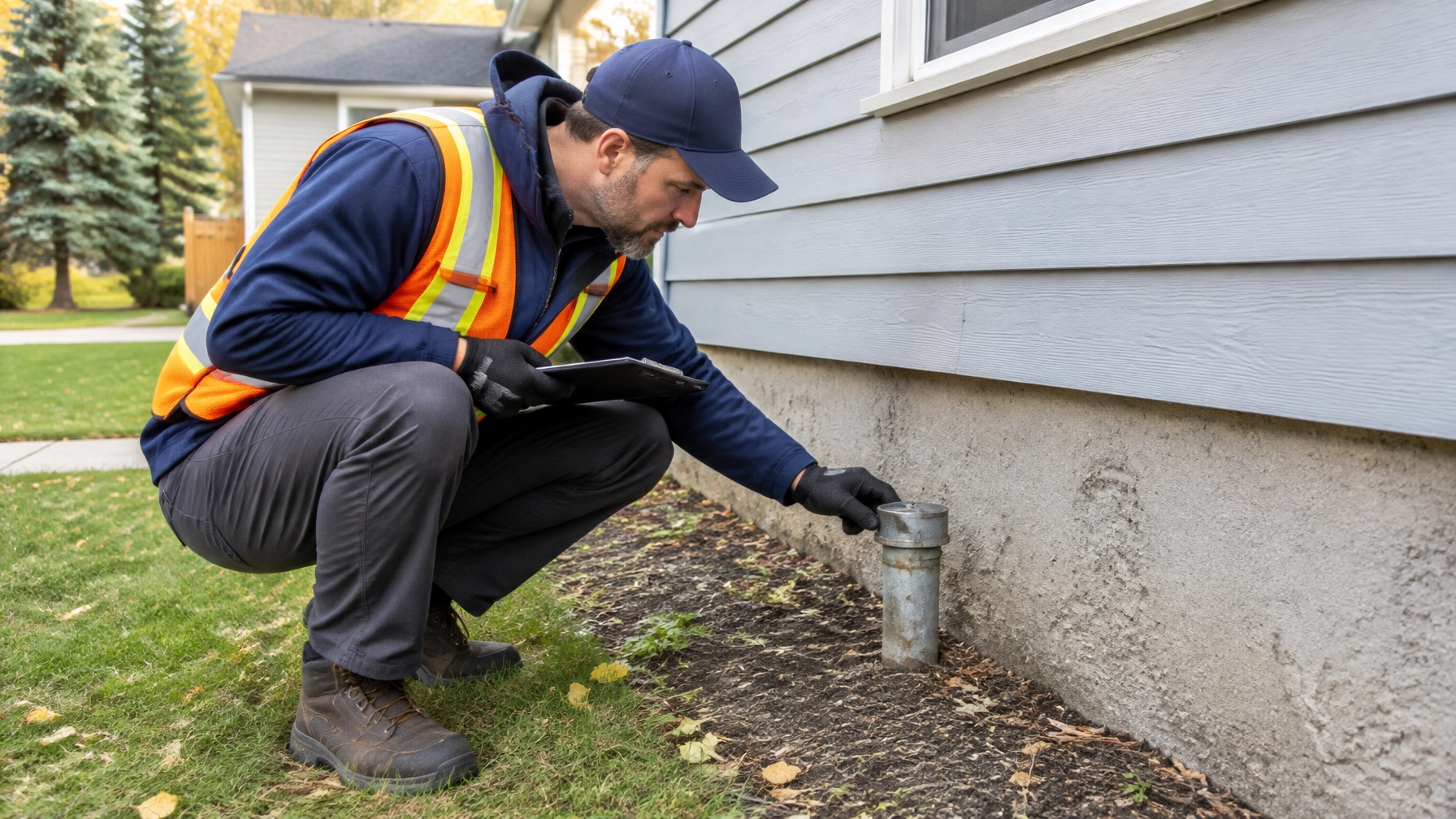
A buried oil tank is invisible to a standard home inspection, but the fill pipe, vent and copper lines that once fed it often are not. If you find them, settle the tank's history before you remove conditions.
Meta description: A buried oil tank can hide under any older Edmonton yard. Here is what an oil tank inspection can spot, what Alberta records show, and what to ask first.
It may be nothing, or it may be a clue to an old underground oil tank. If no one has mentioned a tank, it’s reasonable to ask questions before your purchase conditions expire.
I’m Banti K Shaw. With more than 10 years in construction and inspection in Edmonton, I’ve learned that careful observation is useful, but it is not a substitute for testing something hidden underground. A buried tank may be inactive and still present. If a leak is discovered, the current owner may face significant financial liability, and corrosion inside an old tank is slow, so a tank can release fuel for years before anyone notices. The point is not to assume the worst; it is to establish the tank’s history and condition before you decide how to proceed.
“I cannot see through your driveway, and neither can any other inspector. What I can do is tell you whether the pieces that used to connect to a tank are still there, and then recommend specialist evaluation before you own the problem.”
Banti K Shaw, InspecUs
A standard home inspection is visual and non-invasive. I can observe accessible areas and note visible clues, but I cannot see underground, confirm that a buried tank is present, or rule one out. Nor does a home inspector test a tank for leaks. Book an oil tank inspection in Edmonton expecting a careful look at the surface, not a camera in the ground.
We may see surface features such as pipe stubs, staining or patched concrete. Those observations can help you decide whether to seek a specialist evaluation. They cannot establish what is below the yard, whether a tank is active, or whether it has leaked.
That distinction is part of an honest inspection. For more on the scope of a pre-purchase home inspection in Edmonton, see our guide. For information about potential hazards and inspection considerations, consult InterNACHI’s underground fuel storage tank guidance.
Heating oil was usually stored in tanks that were underground, in basements, or above ground outside the house, so the clues are not always buried. The following observations are clues, not proof of an underground oil tank or a leak. Look at the property as a whole, and ask about anything that seems out of place. A capped stub by a sidewalk deserves the same question as a pipe end at the foundation wall.

“An oil tank that was decommissioned properly has paperwork. An oil tank that somebody forgot about has a pipe stub and a patch of dead grass. Both look quiet. Only one of them is finished.”
Banti K Shaw, InspecUs
Alberta’s Environmental Site Assessment Repository (ESAR) has been discontinued. The province directs users to the Environmental Records Viewer (ERV) for available environmental information, documents and data.
The ERV’s Long Term Management module includes information about certain contaminated sites and publicly available technical documents. An open case is undergoing assessment, exposure control, monitoring or remediation and awaits a remediation certificate. A closed case has been confirmed as not exceeding Alberta Soil and Groundwater Remediation Guidelines and has received a remediation certificate. See the Government of Alberta’s ESAR update for details.
The Safety Codes Council Storage Tanks Search Request provides a way to request historical tank records for a specific property.
Important: A clean search does not prove there is no buried tank. Records may not tell the whole story. A search result also needs interpretation; ask the seller and, where needed, a qualified environmental professional to help make sense of it.
If clues or records raise a concern, ask a qualified specialist what investigation fits the property. InterNACHI describes several possible methods:
These tests are not part of a standard home inspection. A specialist should recommend the appropriate method and explain what its results can and cannot establish.
A leaking tank may need to be removed or filled with a chemically inert solid, such as sand. The appropriate approach depends on the tank and site. Treating or removing the tank, water and affected soil is called remediation, and it is not guaranteed to succeed.
The Safety Codes Council says permitted storage-tank work must be completed, inspected and approved before the system is put into service, and identifies CPCA/TSSA-certified individuals as qualified to install, remove, repair or maintain AST and UST systems. Its guidance also describes removal permits for storage tanks or systems. Requirements can depend on the tank and location, so confirm the permit requirements for the specific property with the local authority having jurisdiction. Start with the Council’s installations, alterations and removals information. The Government of Alberta’s fuel-tank information explains how responsibilities differ between accredited municipalities and unaccredited areas.
Where contamination is suspected or confirmed, ask an environmental professional what assessment, remediation and documentation are appropriate. In serious cases, ask whether a record of site condition is relevant. Don’t assume that a tank has been properly closed just because it is no longer in use.
The land around the tank is part of the file too. A yard that slopes back toward the house keeps the soil around an old tank wetter, and wet soil makes corrosion harder to read on the surface. Our guide to lot grading before the ground freezes covers what the grade can tell you before winter.
If the property is an acreage, remember that underground fuel concerns are only one part of due diligence. Our guides to acreage inspections in Edmonton and assessing wells and septic systems in winter cover other systems that may need separate attention.
Keep the questions clear and save the answers and documents with your purchase records:
If the answers are incomplete or raise concerns, consider asking a specialist for further assessment before you remove conditions. For questions about contractual options or remedies, speak with your lawyer.

It can pose a safety concern and financial liability if it leaks. A tank’s presence alone does not establish that it has leaked; specialist evaluation is needed to assess its condition.
Visible clues may include fill or vent pipes, copper fuel lines, capped stubs, staining, a concrete patch or dead vegetation. These clues do not confirm a tank. Check available records and consult a qualified specialist.
A standard home inspection cannot see underground, confirm a buried tank or rule one out. An inspector can note visible clues and recommend specialist evaluation, but does not test the tank.
Responsibility depends on the circumstances and the parties’ agreements. Ask for the tank’s history and records in writing, get specialist advice, and consult your lawyer about contractual remedies.
If you’re seeing a pipe stub, a patch or another unexplained clue, start by documenting it and asking for the property’s history. At InspecUs, we’ll tell you what the surface shows you, and where its limits are. Send us a message to discuss a property inspection in Edmonton.
We are licensed by the Licensed Professional and certified through InterNACHI

InspecUs Home Inspection is certified in the best practices established by Internachi. Our commitment to safety includes maintaining a 6-foot distance and using personal protective equipment (PPE) during all inspections.

© 2024 InspecUs - All Rights Reserved. | Sitemap | Developed by Integrated Marketing Platform Inc.