 7132 178 St NW,

 Call us:



 Call us780-809-1056
- Mail usinfo@inspecus.ca
- Schedule An Inspection
Call us780-809-1056

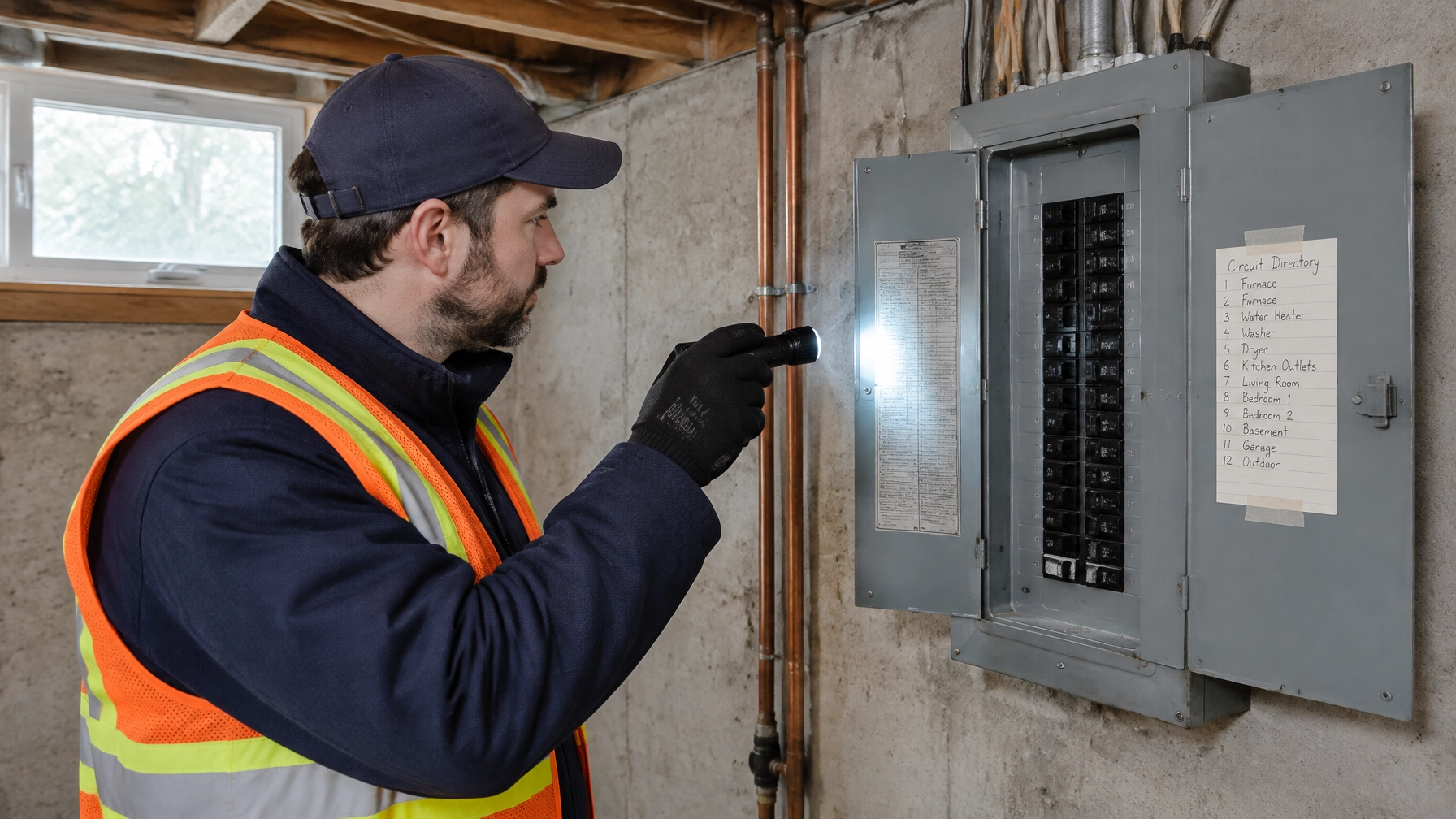
A Federal Pacific or Federal Pioneer Stab-Lok panel has never been recalled as a class in Canada. Your inspector can read the label and look for heat damage, but only a licensed electrician can confirm whether the breakers still trip as designed.
Meta description: No blanket Stab-Lok recall exists in Canada. Here is what an Edmonton buyer can check on a Federal Pacific panel, and what only an electrician can test.
By Banti K Shaw, InspecUs
Are you in a 1970s Edmonton basement, looking at a grey panel with a “Stab-Lok” label and reading on your phone that it was recalled? I understand why that sounds alarming. I’m Banti K Shaw, an InterNACHI-certified home inspector with more than 10 years of construction and inspection experience. The important distinction is this: the brand name is not the finding. The record describes an investigation into certain U.S. breakers and a separate Canadian replacement program for two specific breaker models, not a recall of every Federal Pacific or Federal Pioneer panel.
In 1983, the U.S. Consumer Product Safety Commission (CPSC) closed its two-year investigation into Federal Pacific Electric Stab-Lok residential breakers. The investigation began after the manufacturer’s parent reported that many breakers did not fully meet Underwriters Laboratories calibration requirements. Commission testing confirmed failures of certain requirements, primarily in two-pole residential breakers made before Reliance acquired FPE in 1979.
The CPSC said the information available did not establish a serious risk of injury, and that it could not link the test failures to a hazardous situation at that time. It closed the matter without deciding whether the breakers were safe or whether the manufacturer’s position was accurate. That was an investigation closure, not a panel recall or a safety certification. You can read the CPSC’s release and safety guidance.
Could a particular breaker in the panel be covered by a Canadian notice? Yes, but it is a narrow, breaker-level program.
The Electrical Safety Authority (ESA) alert covered Federal Pioneer NC015 and NC015CP Stab-Lok breakers: single-pole, 15-amp models manufactured between August 1, 1996 and June 11, 1997. Schneider Canada announced a voluntary replacement program because some of these breakers may not trip.
The alert describes the affected units as having a square or rectangular blue handle. Replacement breakers are identified by either a hole drilled in the blue handle or, for breakers made after January 1, 1999, a rounded, ribbed blue handle. The ESA alert says a blue handle with a hole, a rounded and ribbed blue handle, and black-handled breakers are not impacted by that notice. See the ESA product safety alert for the full identification details.
This notice applies to two specific 15-amp breaker models from a ten-month manufacturing window. It is not a recall of a Federal Pioneer panel, every Stab-Lok panel, or every Stab-Lok breaker.
Does a breaker that looks similar mean it is an approved replacement? Not necessarily. Schneider Electric Canada says non-authentic breakers not manufactured by Schneider Electric, even those that may look similar, have not been tested for use in Stab-Lok loadcentres. Its FAQ on non-authentic Stab-Lok breakers explains this point.
A licensed electrician can identify the breaker models and assess whether the installed breakers are appropriate for that loadcentre. Don’t remove the panel cover, touch a breaker, or try to test one yourself. A photograph of the closed panel and its label can help an electrician understand what you’re asking about, but a photo cannot establish whether a breaker trips as designed.
What can I responsibly tell you during a standard home inspection? Under the InterNACHI Standards of Practice, an inspector visually checks electrical components including the panelboard and over-current protection devices, service equipment, grounding and bonding, and a representative number of receptacles, switches and lights. I describe the main disconnect’s amperage rating if it is labelled and the type of wiring observed. I report visible conditions that need correction, such as evidence of arcing or excessive heat, an unfilled panel opening, or readily visible solid-conductor aluminum branch wiring.
The same standards say an inspection is not technically exhaustive and does not identify concealed or latent defects, determine insurability, or establish a component’s service life. An inspector is not required to insert tools or probes into a panel, remove its cover or dead front, operate or reset breakers, or determine unlabeled service amperage. Testing whether a breaker trips is not part of a standard visual home inspection.
“When I see a Stab-Lok label, I treat it as a reason to be precise, not dramatic. I can describe the label and visible conditions, but I cannot test a breaker or certify its performance during a standard home inspection.”
Banti K Shaw, InspecUs
For a fuller overview of what an electrical inspection in Edmonton covers, see our electrical inspection guide.
How can you gather useful information safely before asking for professional advice? Keep the panel closed and limit your checks to what you can see without touching electrical equipment:

As general guidance for all breakers and fuses, the CPSC advises knowing which outlets and products are on each circuit, avoiding circuit overloads, especially several high-current heating appliances on a low-amperage circuit, and following local codes with correctly sized wiring and protection. Disconnect a product that develops problems and have it examined. If a breaker trips or a fuse blows, investigate the reason rather than simply resetting or replacing it; when in doubt, consult a licensed electrician.
Could the service capacity or wiring matter as much as the panel label? Yes. The Insurance Bureau of Canada says 60-amp service was commonly installed in the pre-war era and suited the electrical needs of that time, but is insufficient for modern homes. It notes that overuse can raise overheating and fire risks, and that coverage or surcharges can be affected. IBC advises homeowners with 60-amp service to contact their insurance representative.
Aluminum wiring is another consideration in some homes built during the suburban expansion from the 1960s to the 1990s. IBC notes it was often installed incorrectly; aluminum can heat up, and its expansion and contraction can contribute to loose connections. The ESA recommends a Licensed Electrical Contractor assess its condition. Read IBC’s home history and potential issues guide, and see electrical red flags in Edmonton.
If the panel condition is confirmed, discuss it with your own insurance representative. I cannot determine a property’s insurability during an inspection; you can also read more about what a home inspection can do for your Edmonton insurance.
What information helps you make a decision without relying on a brand name alone? Ask clear, specific questions:
I inspect homes; I do not replace panels, perform electrical work, pull permits, or test breakers under load. Panel work should be assessed by a licensed electrician in Alberta, with a permit from the permitting authority in your area where required.
“I don’t want a brand name to become a negotiating weapon in either direction. Get the electrician’s written opinion about the actual panel and breakers before you decide whether to proceed or remove conditions.”
Banti K Shaw, InspecUs
If the inspection identifies concerns, consider using your purchase conditions to get the appropriate professional advice before you commit. Our guide explains what you give up if you waive a home inspection contingency in Alberta. You can also review electrical inspections in Edmonton FAQs and how to read your home inspection report.

No. The records discussed here do not say that Federal Pacific or Federal Pioneer Stab-Lok panels are illegal, banned, or prohibited. The ESA notice concerns two specific breaker models, not a panel class.
I can’t determine that, and I won’t guess about an insurer’s rules. IBC advises homeowners with 60-amp service to contact their insurance representative because coverage and surcharges can be affected. Ask your own insurer about any confirmed panel condition.
Don’t try to replace breakers yourself. Have a licensed electrician identify the panel and breaker models, check the specific ESA notice if relevant, and advise on appropriate work.
A brand label alone doesn’t answer that. Get the visible conditions documented, obtain an electrician’s written opinion if needed, and weigh the findings alongside the rest of the property and your purchase terms.
Would a clear, unbiased inspection help you understand the panel in context? I can document the visible condition and explain what I can, and cannot, conclude under a standard inspection. If you want to talk through a property or arrange an inspection, you can book your Edmonton home inspection.
We are licensed by the Licensed Professional and certified through InterNACHI

InspecUs Home Inspection is certified in the best practices established by Internachi. Our commitment to safety includes maintaining a 6-foot distance and using personal protective equipment (PPE) during all inspections.

© 2024 InspecUs - All Rights Reserved. | Sitemap | Developed by Integrated Marketing Platform Inc.