 7132 178 St NW,
 Call us:

 Call us780-809-1056
- Mail usinfo@inspecus.ca
- Schedule An Inspection
Call us780-809-1056

Direct Answer: In Edmonton, radon testing should follow Health Canada guidelines using a long-term test (minimum 3 months) in the lowest regularly occupied level during the heating season. Corrective mitigation is recommended if annual average levels exceed the Canadian guideline of 200 Bq/m³. With roughly 1 in 7 Edmonton homes showing elevated radon levels, testing is an essential step for every homeowner and real estate buyer.
Are you buying a new home in Edmonton or wondering if the air you and your family breathe every day is completely safe? When evaluating a property, most people focus heavily on visible details: the roof shingles, the furnace age, or the condition of the kitchen countertops. But what about the invisible threat lurking quietly in the basement?
As a certified home inspector with over a decade of hands-on construction and inspection experience across Edmonton, St. Albert, Sherwood Park, and surrounding areas, I have seen firsthand how much peace of mind comes from understanding indoor air quality. Radon gas is completely colorless, odorless, and tasteless, making it impossible to detect without specialized testing equipment. In this comprehensive 2026 guide, we will break down everything you need to know about radon testing in Edmonton, what the guidelines mean for your real estate transaction, and how to protect your investment.
Why do so many Edmonton homeowners remain completely unaware of radon until it is flagged during a real estate transaction? Radon is a radioactive gas formed by the natural breakdown of uranium in soil, rock, and groundwater. As it escapes into the outdoor air, it dilutes quickly to harmless levels. However, when it enters an enclosed structure like a home through foundation cracks, sump pits, or utility penetrations, it can accumulate to dangerous concentrations.

Alberta: and the Edmonton region in particular: has geological soil compositions that naturally generate higher levels of uranium. According to provincial and national studies, approximately 1 in 7 Edmonton homes exceed Health Canada’s action threshold. Because our winters are long and cold, our homes remain tightly sealed for much of the year with windows closed and heating systems running, which creates a negative pressure zone that effectively draws soil gases upward into living spaces.
"In my 10+ years inspecting homes across Edmonton, I cannot stress enough that radon has nothing to do with whether a house is old or brand-new. I have tested pristine newly constructed homes that had elevated levels simply due to soil permeability and foundation pressure dynamics. Testing is the only way to know for sure." : Banti K Shaw, Founder of InspecUs
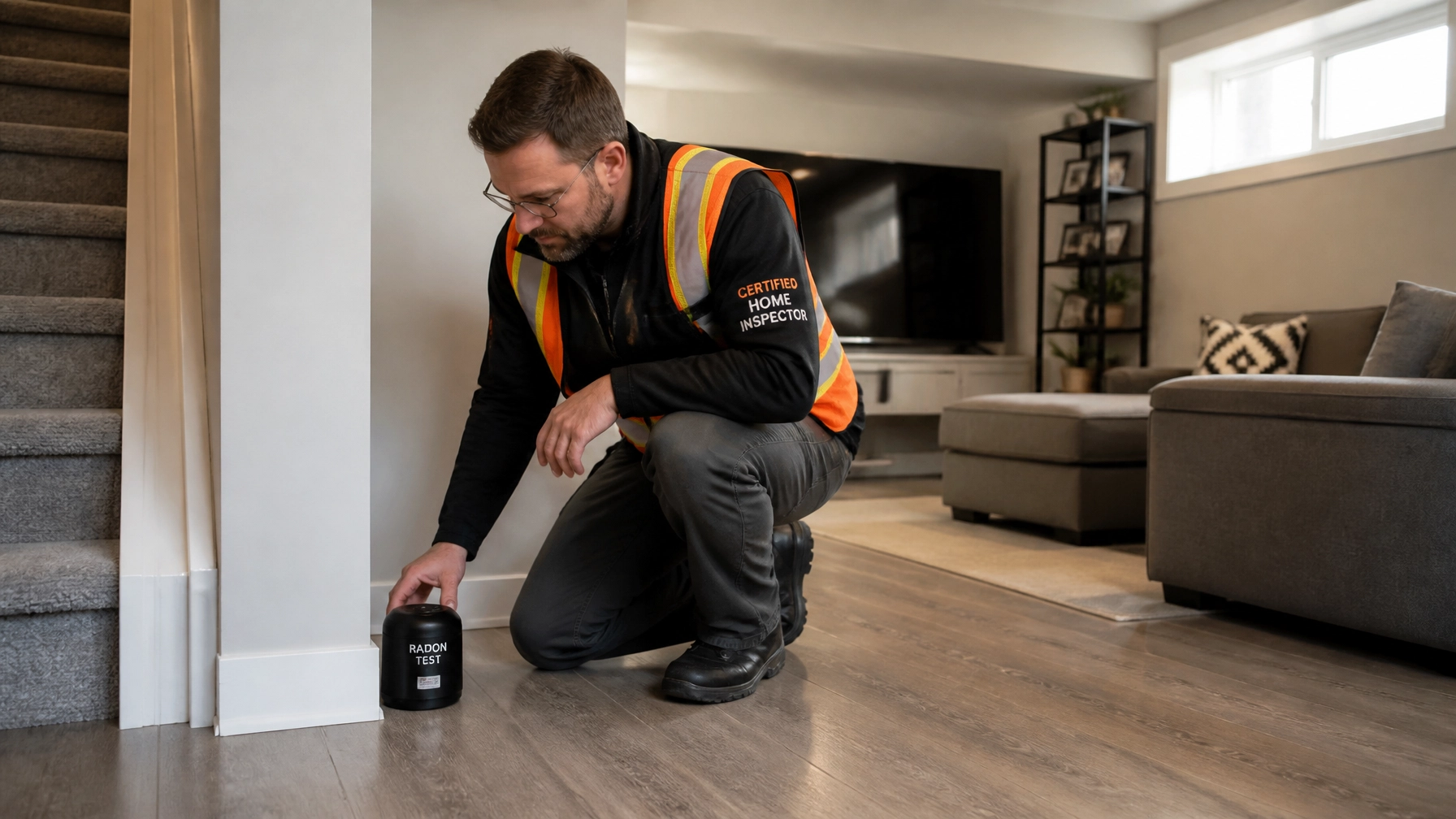
Are you wondering how radon is accurately measured without disrupting your daily routine? Understanding the testing protocol is essential, especially when you are in the middle of buying or selling a property.
Health Canada strongly recommends using a long-term test kit for a minimum of 3 months (91 days). Because radon levels fluctuate daily based on weather, barometric pressure, and occupant habits, a long-term measurement captures the true annual average concentration in your home.
What happens if you are in a fast-paced real estate purchase and cannot wait three months for test results? While short-term screening tests (lasting 48 hours to a few days) can provide a rapid snapshot during conditional purchase periods, they do not replace long-term testing.
Pro Tip for Homebuyers: If you use a short-term screening test during your pre-purchase condition period, treat the results as an initial indicator only. Plan to install a long-term testing kit immediately after taking possession to establish an accurate annual baseline. When scheduling your property assessment, combining a thorough certified home inspection with comprehensive environmental sampling gives you complete clarity before removing conditions.
How do you know when a radon reading requires immediate action? Health Canada’s guideline sets the national benchmark at 200 becquerels per cubic metre (200 Bq/m³) for normal occupancy areas.

Let's break down how to interpret your test results:
If you are unsure who to trust for follow-up testing or broader due diligence, this guide on choosing the best home inspector in Edmonton can help you evaluate qualifications, tools, and reporting standards.
What should you do if your test results come back higher than 200 Bq/m³? Discovering elevated radon can feel alarming at first, but the good news is that radon mitigation is highly effective and straightforward.
Professional radon mitigation typically involves installing a Sub-Slab Depressurization (SSD) system. Here is how the process works:
Most residential mitigation systems can be installed in a single day by a certified C-NRPP professional, immediately reducing indoor radon levels by 90% or more.
Are you currently navigating a home purchase or preparing to list your property? Integrating radon awareness into your transaction protects both buyers and sellers from unexpected post-closing disputes.
For homebuyers, reviewing existing test history or scheduling independent testing during a pre-purchase home inspection ensures you understand potential remediation costs upfront. If elevated radon is discovered, it should be treated like any other structural or mechanical repair: negotiated fairly between parties. Because indoor air quality concerns often overlap, it is also worth understanding related issues like moisture-driven contamination by reading our guide on mould inspection in Edmonton for homeowners and buyers.
For homeowners selling a property, proactive testing demonstrates transparency and builds immediate trust with prospective buyers. Providing documented test results can set your listing apart in the competitive Edmonton real estate market.

Navigating indoor air quality and property health doesn't have to be overwhelming. At InspecUs, our mission is to empower Edmonton homeowners, buyers, and investors with honest, unbiased, and thorough property assessments. Backed by 10+ years of construction and inspection expertise, InterNACHI certification, and state-of-the-art diagnostic tools, we deliver reports within 24 hours so you can make confident, informed decisions.
Ready to schedule your comprehensive property assessment or have questions about air quality and thermal imaging? Explore our full suite of services, including thermal imaging and moisture detection and comprehensive inspection services.
Contact InspecUs today or call us directly at 780-809-1056 to book your inspection!
We are licensed by the Licensed Professional and certified through InterNACHI

InspecUs Home Inspection is certified in the best practices established by Internachi. Our commitment to safety includes maintaining a 6-foot distance and using personal protective equipment (PPE) during all inspections.

© 2024 InspecUs - All Rights Reserved. | Sitemap | Developed by Integrated Marketing Platform Inc.