 7132 178 St NW,

 Call us:



 Call us780-809-1056
- Mail usinfo@inspecus.ca
- Schedule An Inspection
Call us780-809-1056

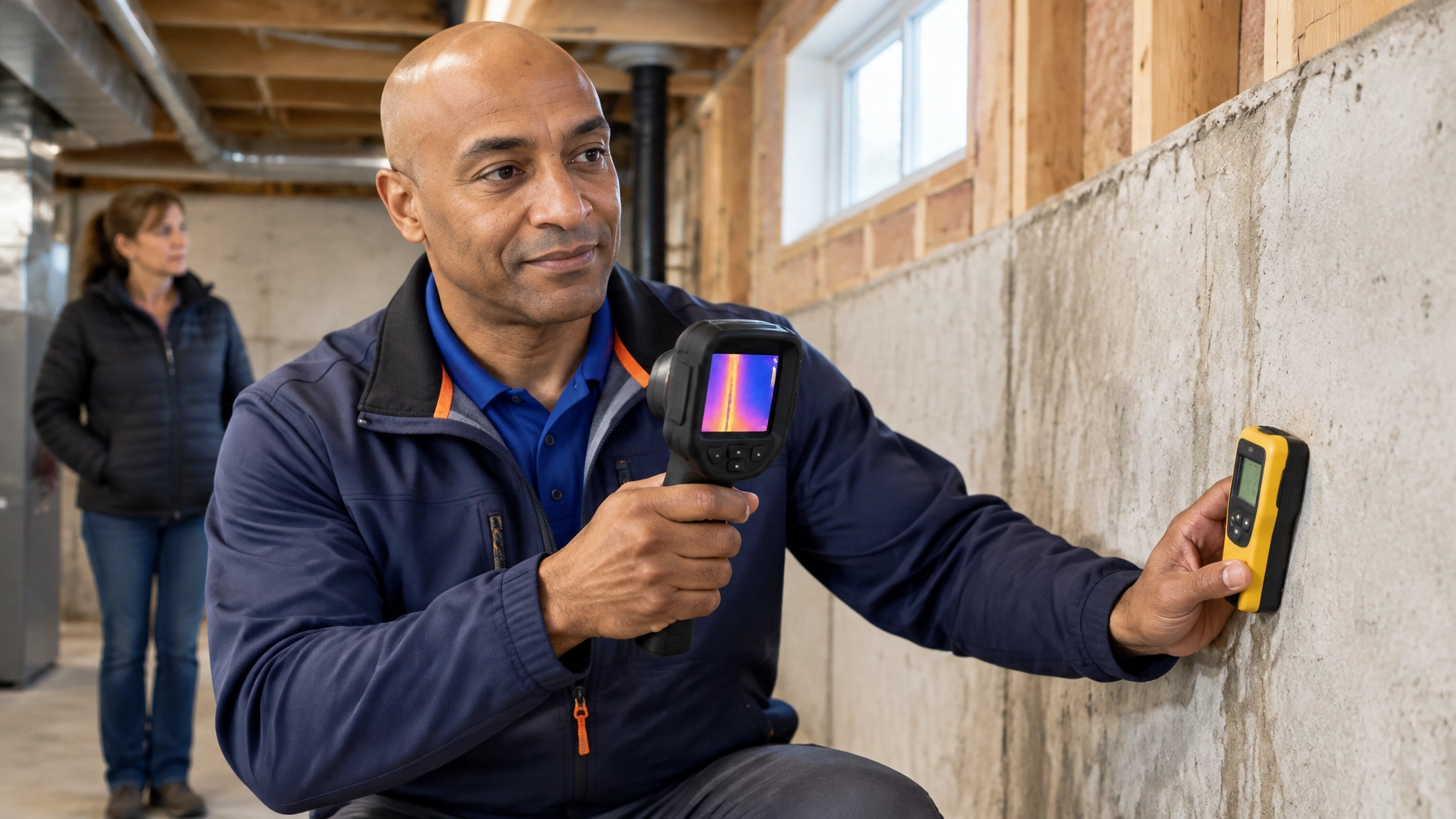
Health Canada sets no safe mould exposure limit and does not recommend testing indoor air for mould. What matters is finding the moisture source, fixing it and cleaning up what is growing, whatever the species.
Meta description: Health Canada sets no safe mould limit and does not recommend air testing. Here is what to check instead in Edmonton and when sampling actually helps.
You’ve found a patch, noticed a musty smell, or received a seller’s mould test report. So what do you hope the test will settle? Usually, it’s whether the home is safe, whether hidden mould is present, or whether a seller has solved a problem.
Those are understandable concerns, but an air sample cannot answer all of them. In my 10+ years in home inspection and construction, I’ve learned to focus first on the building condition: where moisture is getting in, how far it has travelled and whether the cause was corrected.
“When I find mould, the first question is never what kind it is. It is how big, what is hiding behind it, and what is leaking. I have never seen a lab report answer those three.”
Banti K Shaw, InspecUs
Whether a company calls it a mold inspection or a mould inspection, the question is the same: what will this inspection establish, and would the test result actually change what you do next?
Could a test number tell you what level of mould is safe? Health Canada says there is no “safe” limit for mould. Its Residential Indoor Air Quality Guideline: Moulds explains that the variety of mould species and differences in individual responses prevent setting an exposure limit. Without that limit, results from indoor-air tests cannot be used to assess health risks to occupants.
Instead, Health Canada recommends controlling humidity, repairing water damage and thoroughly cleaning visible or concealed mould, regardless of the species. Its mould guidance also says that, in most cases, you don’t need to measure the concentration in the air or identify the species. Find and fix the moisture and mould problem.
Health Canada identifies possible effects associated with mould and dampness, including irritation, coughing, wheezing, shortness of breath, worsening asthma symptoms and other allergic reactions. Children, seniors and people with asthma or severe allergies may be more susceptible. If you have health concerns, discuss them with a healthcare professional.
What does a sample actually show? Health Canada says air testing generally does not predict health effects and often provides little information about the cause of mould damage.
An air test may:
It cannot, by itself:
“A spore count can come back clean on Tuesday and that wall is still wet on Wednesday. What I care about is where the water came from, how long it has been there and whether anybody actually fixed it.”
Banti K Shaw, InspecUs
A clean air sample is not evidence that a house is dry.
Is there a situation where air sampling makes sense? Yes, but it’s a narrower one. Health Canada says a qualified professional may recommend a non-viable air test when concerns remain unexplained after an inspection for dampness and mould, especially after flooding, a roof leak or a pipe leak that may have affected wall cavities. Microscopy of machine-collected samples can detect specific indicator mould types; high counts may help direct further investigation.
If laboratory work is proposed, ask whether the lab is accredited to ISO/IEC 17025:2017 by CALA, SCC, AIHA or an equivalent accreditation body. And ask why the sample is needed: what question will it answer, and how could the result change the next step?
Health Canada says a systematic approach based on thorough visual inspection is usually more effective than extensive air, bulk or swab testing. For unexplained odours and dampness, consider a targeted investigation rather than testing first.
Does the amount of visible growth affect what to do? Health Canada’s guide describes these categories:
Mould that keeps returning after cleaning, suspected hidden growth or a flood that reached wall cavities are also reasons to involve a qualified professional.
What signs can help you decide whether further investigation is needed? Walk through damp areas and places with a history of leaks or water damage. Look for:
Health Canada notes that mould can begin growing in an area with excessive moisture within 48 hours. If there’s a strong musty smell but no visible source, ask a professional about possible hidden mould in wall, ceiling or floor cavities. Its moisture and mould guide also advises against bleach and cautions that painting over mould only hides the problem temporarily.

A practical prevention step: Health Canada recommends keeping relative humidity between 30% and 50%. Run the bathroom fan during a shower or bath and for at least 30 minutes afterward. We covered the condensation side of this in our guide to winter window condensation and mould in Edmonton.
How can you judge whether a proposed service is focused on solving the problem? Ask the professional:
A credible professional should be able to explain why any sampling is proposed and what decision it will inform, not simply offer a number without context.
What should you make of a seller’s mould report? Treat it as one document about the testing performed, not proof that the moisture source was fixed, that the property is dry today or that no concealed issue remains. Ask what areas were inspected, what prompted the sampling, what the results mean and what repairs were completed. Request invoices, repair details and any follow-up documentation.
For a pre-purchase assessment, I start with observable conditions and evidence of moisture. If you are booking a mould inspection in Edmonton before you buy, clarify whether you are hiring for a visual building inspection, targeted sampling or remediation. They answer different questions.
At InspecUs, a home and property inspection is visual and non-invasive. Moisture metering and thermal imaging can help flag areas that warrant attention, but they don’t confirm what is growing inside a cavity. Read more about spotting moisture problems and how thermal imaging can help identify hidden water concerns.

Health Canada says there is no “safe” limit for mould. It does not recommend using an indoor-air spore count to assess occupant health risk. Focus on finding and correcting moisture and cleaning mould.
Health Canada says not to use bleach to clean mould. Follow its cleaning guidance for small or medium areas, including using an unscented soap solution on washable surfaces, and address the moisture source. Get professional help for extensive growth or recurring mould.
Usually, identifying a species does not change the recommended response. Health Canada advises controlling humidity, repairing water damage and cleaning mould regardless of species. If sampling is being considered, ask a qualified professional what specific question it will answer.
A home inspection is visual and non-invasive; it does not open walls. Thermal imaging and moisture metering can flag possible hidden moisture, but they cannot confirm what is growing inside a cavity. If there are strong musty odours, a history of leaks or unexplained dampness, ask whether further investigation is appropriate.
If you’ve noticed a musty smell, found visible growth or are reviewing a seller’s mould report, start by asking what evidence shows the moisture source was corrected. If you’d like to discuss an inspection or moisture concerns in an Edmonton property, contact InspecUs and we can help you consider a sensible next step.
We are licensed by the Licensed Professional and certified through InterNACHI

InspecUs Home Inspection is certified in the best practices established by Internachi. Our commitment to safety includes maintaining a 6-foot distance and using personal protective equipment (PPE) during all inspections.

© 2024 InspecUs - All Rights Reserved. | Sitemap | Developed by Integrated Marketing Platform Inc.