 7132 178 St NW,
 Call us:


 Call us780-809-1056
- Mail usinfo@inspecus.ca
- Schedule An Inspection
Call us780-809-1056

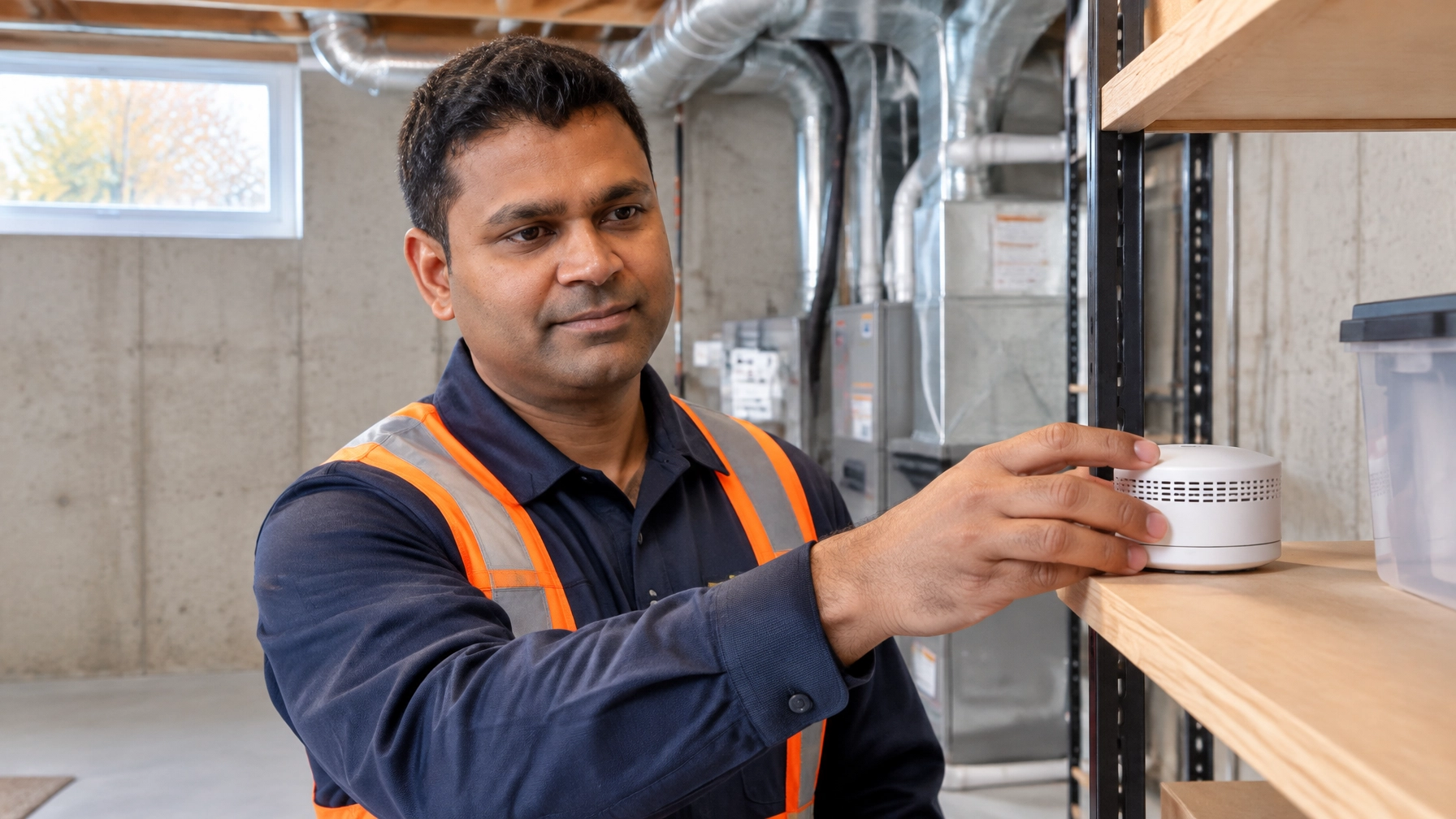
Direct answer: For radon testing in Edmonton, use a long-term test for at least three months, ideally in fall or winter, on the lowest lived-in level. Health Canada’s guideline is 200 Bq/m³; no level is risk-free, and results above it call for corrective action within one year, sooner at higher levels.
As September 2026 brings cooler temperatures and the start of Edmonton’s heating season, now is an ideal time to test your home for radon. During fall and winter, windows remain closed, homes are heated, and pressure differences can draw more soil gas through foundation cracks and floor penetrations.
I’m Banti K Shaw, and after more than 10 years in construction and property inspection, I’ve learned that radon is one of the most important home hazards you cannot see, smell, or taste. Testing is the only reliable way to know your household’s exposure.
Could your basement have elevated radon even if the home looks perfectly maintained? Yes. Radon is a naturally occurring radioactive gas released from soil and rock. It can enter through:
According to the Take Action on Radon Edmonton Community Report from July 2024, 24% of the 163 homes tested in an Edmonton community project during winter 2023 measured above 200 Bq/m³. The homes represented less than 1% of Edmonton dwellings, so this result does not represent every property, but it demonstrates why you should test your own home rather than rely on neighbourhood assumptions.
Radon levels are also typically about 50% higher in basements than on ground floors. If your basement includes a bedroom, office, family room, or other area where you spend significant time, testing there is especially important.
Banti’s insight: “In construction, we routinely look for visible defects and water entry. Radon is different: a home can have excellent finishes and still have elevated radon. A properly placed long-term test gives you information that a visual inspection cannot.”
Is any radon reading completely safe? No. Health Canada states that there is no level of radon exposure considered risk-free.
Canada’s guideline is:
Health Canada recommends corrective action within one year when the average annual radon level exceeds 200 Bq/m³. The higher the concentration, the sooner you should respond. The goal is to reduce radon as much as reasonably practicable, not simply to get just below the guideline.
Read the full Health Canada radon guideline for the official recommendations.
What should you budget for radon testing in Edmonton in 2026? The price depends on whether you use a do-it-yourself kit or hire a professional.
Typical estimates are:
A low-cost test is not necessarily a poor choice, provided it is an appropriate long-term device, placed correctly, and analysed through a reliable process. If you are buying or selling a property, professional guidance may be worthwhile because timing, documentation, and test placement can affect your decision.
A radon test is a relatively small investment compared with the cost of a home, foundation repairs, or future mitigation. If you are already arranging a pre-purchase home inspection in Edmonton, ask whether radon testing can be added or coordinated separately.
Do you need a result before your offer condition expires? It depends on the type of test.
Short-term tests may run for approximately two to seven days. They can provide a quick screening result, but radon levels fluctuate with:
A short-term result should not automatically be treated as your annual average.
Health Canada recommends a long-term test for a minimum of three months, or at least 91 days. This provides a more representative estimate of average exposure.
For the most useful result:
Health Canada’s testing your home for radon guidance explains the two main options: a do-it-yourself kit or a radon measurement professional.

Do Alberta homebuyers have to complete a radon test before purchasing? Generally, no. As of 2026, radon testing is not normally a mandatory part of a standard home inspection or ordinary residential real estate transaction in Alberta.
However, “not legally required” does not mean “unnecessary.” You can:
Building requirements may include radon-resistant features or rough-ins in new construction, but a rough-in does not confirm that indoor radon levels are low. Only measurement can provide that information.
A standard home inspection can identify conditions that may permit soil gas entry, such as cracks, sump pits, or foundation penetrations. It does not measure radon unless a separate radon test is specifically arranged.
Would a thorough visual inspection automatically reveal radon? No. Radon has no smell, colour, or visible signature. Thermal cameras, moisture meters, and visual inspection tools cannot directly measure it.
A home inspection may identify:
But a radon detector or laboratory test is required to determine the actual concentration.
This is also why radon testing should not be confused with a mold inspection in Edmonton. Mold concerns are usually investigated through visual assessment, moisture readings, thermal imaging, and: when appropriate: air or surface sampling. Radon requires a separate measurement process.
What happens if your long-term result is above 200 Bq/m³? The most common solution is radon mitigation, usually through an active sub-slab depressurization system.
This system typically:
Other measures may include sealing accessible cracks and penetrations, improving sump covers, addressing crawlspace conditions, and correcting ventilation or pressure problems. Sealing alone is rarely a complete solution because radon can enter through several pathways.
Banti’s pro tip: “Do not spend money sealing one visible crack and assume the problem is solved. Radon mitigation should be based on the test result, the building’s foundation design, and a system that actively controls soil gas movement.”

Are you wondering when to start? September through the winter heating season is a practical window to begin a long-term test.
Use this simple checklist:
If you are buying a home, schedule the standard inspection early enough to discuss radon testing, moisture concerns, and other specialized assessments before your conditions expire. InspecUs provides comprehensive home inspection services in Edmonton and can help you understand which additional inspections may be appropriate for the property.

Radon testing is not about creating unnecessary alarm. It is about replacing uncertainty with useful information. Edmonton homes can have very different radon levels: even neighbouring homes with similar construction: so testing your own property is the responsible approach.
If your result is low, you gain reassurance and a baseline for future testing. If it is elevated, effective mitigation is available. Either way, a long-term test helps you make a better-informed decision about your home, your health, and your investment.
Planning a home inspection or concerned about basement conditions? Contact InspecUs to discuss your next step.
Meta description: Learn radon testing Edmonton costs, safe levels, testing times and mitigation steps for 2026, with Health Canada guidance and expert local tips for your home.
We are licensed by the Licensed Professional and certified through InterNACHI

InspecUs Home Inspection is certified in the best practices established by Internachi. Our commitment to safety includes maintaining a 6-foot distance and using personal protective equipment (PPE) during all inspections.

© 2024 InspecUs - All Rights Reserved. | Sitemap | Developed by Integrated Marketing Platform Inc.