 7132 178 St NW,

 Call us:



 Call us780-809-1056
- Mail usinfo@inspecus.ca
- Schedule An Inspection
Call us780-809-1056

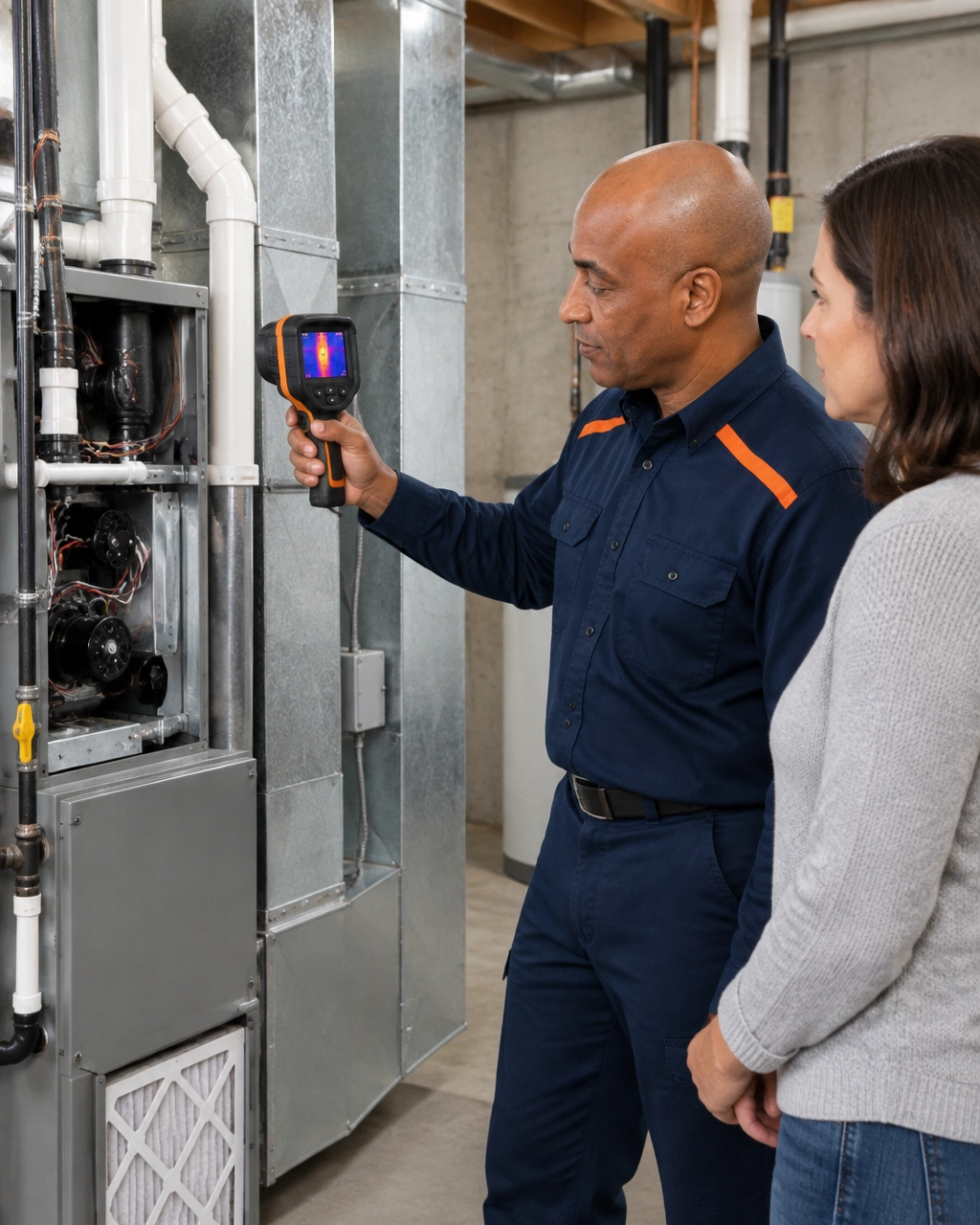
Meta description: Learn what a furnace inspection in Edmonton includes before winter, key furnace warning signs, homeowner prep steps, safety limits, and 2026 cost expectations.
Direct answer: A furnace inspection in Edmonton typically reviews the heating system’s visible condition, operation, venting, exhaust, air filters, ductwork, thermostat, electrical components, and safety concerns. A home inspector reports observable defects, while a licensed HVAC technician handles combustion testing, gas adjustments, repairs, and detailed servicing.
Edmonton homeowners and buyers have a narrow window between late September and the first deep freeze. Your furnace may have worked normally last winter, but that does not guarantee it is ready for months of continuous operation.
I’m Banti K Shaw, founder and chief inspection officer at InspecUs. With more than 10 years of inspection experience and a background in construction, I look at the entire heating system in context: the furnace, venting, air distribution, electrical supply, surrounding structure, moisture conditions, and the way these components affect your home.
Could a small furnace problem become an emergency when temperatures reach -20°C?
That is the risk of waiting until the system fails. During an inspection, I am looking for warning signs that may affect safety, comfort, energy use, or reliability before your furnace is under its greatest workload.
A pre-winter review can help identify:
“My goal is not to create alarm. It is to give you a clear picture of what is visible, what should be monitored, and which concerns deserve prompt attention from a qualified HVAC professional.”- Banti K Shaw
A general home inspection in Edmonton is especially useful when you are buying or selling a property. It is also valuable for homeowners who want a documented maintenance plan before winter.
What happens when an inspector enters the furnace room?
I follow a practical, chronological process. The exact scope depends on access, equipment type, and safety conditions, but these are the main stages of a standard heating-system review.
First, I identify the furnace type, approximate age, fuel source, installation location, and accessible service areas.
I look for:
A furnace does not need to be new to be safe and functional. However, older systems may have more wear, lower efficiency, discontinued parts, or a greater likelihood of replacement in the near future.
Next, I operate the thermostat and observe the furnace through an available heating cycle.
I assess whether:
Short-cycling means the furnace turns on and off too frequently. The cause may be restricted airflow, an oversized furnace, a dirty filter, thermostat problems, or a safety control responding to abnormal conditions.
Could a simple filter problem be making your furnace work harder?
A clogged filter restricts airflow, which can reduce comfort and place additional strain on the blower and heat exchanger. I check the accessible filter, return-air openings, supply ducts, registers, and visible insulation.
I note:
Pro tip: Replace the filter according to the manufacturer’s instructions. A high-efficiency filter is not automatically better if your system cannot move air through it properly.

What keeps combustion gases out of your home?
For gas furnaces, safe venting is one of the most important areas I review. I inspect accessible vent pipes, connections, supports, clearances, and exterior terminations.
I look for:
A blocked high-efficiency furnace exhaust can cause the system to shut down. More serious venting or combustion problems can create a carbon monoxide hazard.
If a carbon monoxide alarm sounds, leave the home immediately and call 911 or your local emergency service from outside. Do not continue operating suspected equipment until it has been assessed by a qualified professional.
Could a furnace that starts normally still have an electrical concern?
I inspect visible wiring, disconnects, switches, junctions, and accessible controls for damage, loose connections, exposed conductors, or other observable concerns.
A general home inspection is not a repair or electrical commissioning service. I do not remove sealed components, adjust gas pressure, or dismantle the furnace to test internal parts.
The InterNACHI Standards of Practice explain the general boundaries of a home inspection, including visual and non-invasive inspection procedures. When a concern requires testing beyond that scope, I recommend the appropriate licensed HVAC technician, gas fitter, or electrician.
Finally, I consider how the heating system serves the home rather than looking only at the furnace cabinet.
I assess:
A furnace can operate correctly while the home remains uncomfortable because of air leakage, inadequate insulation, poor duct design, or moisture-related damage elsewhere.
For broader seasonal preparation, review the Edmonton fall home inspection checklist.
Are you noticing changes that seem minor but keep returning?
These symptoms do not identify one guaranteed cause, but they are useful signals:
| Observable symptom | Possible underlying cause |
|---|---|
| Furnace turns on and off repeatedly | Restricted airflow, thermostat issue, oversized system, or safety control activation |
| Loud banging during start-up | Delayed ignition, duct expansion, loose components, or blower concerns |
| Squealing or grinding | Worn blower motor, belt, bearing, or moving component |
| Weak airflow at several registers | Dirty filter, blocked return, disconnected duct, or blower problem |
| Yellow or irregular flame | Incomplete combustion or burner/air-supply concern requiring a qualified technician |
| Water around the furnace | Condensate drainage problem, humidifier leak, plumbing leak, or venting condensation |
| Furnace will not start | Thermostat, electrical supply, ignition, control, or safety-switch issue |
| Persistent burning or exhaust odour | Dust may burn briefly at first start-up, but recurring odours require investigation |
| Headaches, dizziness, or flu-like symptoms at home | Possible carbon monoxide exposure; leave immediately and call emergency services |
Do not attempt to repair gas controls, bypass safety switches, alter venting, or open sealed combustion areas yourself.
Would you like your inspection to be more complete and efficient?
Before I arrive, you can:
Your furnace is only one part of winter readiness. Attic insulation and ventilation can affect heat loss, condensation, and ice dams, so thermal imaging and moisture detection in Edmonton may also be appropriate.

What should you budget for before booking?
The cost depends on whether you need a general home inspection, a dedicated HVAC tune-up, diagnostic work, or repairs.
As a practical planning guide:
These are planning categories, not a quote. Ask the provider what is included: combustion analysis, carbon monoxide testing, cleaning, gas-pressure testing, parts, written documentation, and follow-up recommendations.
If a furnace was recently installed, altered, or replaced, consult the City of Edmonton heating and ventilation permit information. Routine maintenance is different from installation inspection and permitting.
Are you buying a home, preparing to sell, or simply trying to avoid a cold-weather surprise?
A furnace-focused review or complete pre-purchase home inspection in Edmonton may be worthwhile if:
At InspecUs, I inspect more than 100 items, use tools such as thermal imaging and moisture meters where appropriate, and provide a detailed report with high-resolution images within 24 hours. If you want a clearer picture of what to expect during an Edmonton home inspection, my reports are independent, practical, and designed to help you decide what matters now, what can be planned, and when a specialist should be involved.

You do not have to wait for a breakdown to understand your heating system. If you would like to discuss your property, you can contact InspecUs to arrange an inspection. A pre-winter inspection is a low-pressure way to enter Edmonton’s coldest months with better information and fewer surprises.
We are licensed by the Licensed Professional and certified through InterNACHI

InspecUs Home Inspection is certified in the best practices established by Internachi. Our commitment to safety includes maintaining a 6-foot distance and using personal protective equipment (PPE) during all inspections.

© 2024 InspecUs - All Rights Reserved. | Sitemap | Developed by Integrated Marketing Platform Inc.