 7132 178 St NW,

 Call us:



 Call us780-809-1056
- Mail usinfo@inspecus.ca
- Schedule An Inspection
Call us780-809-1056

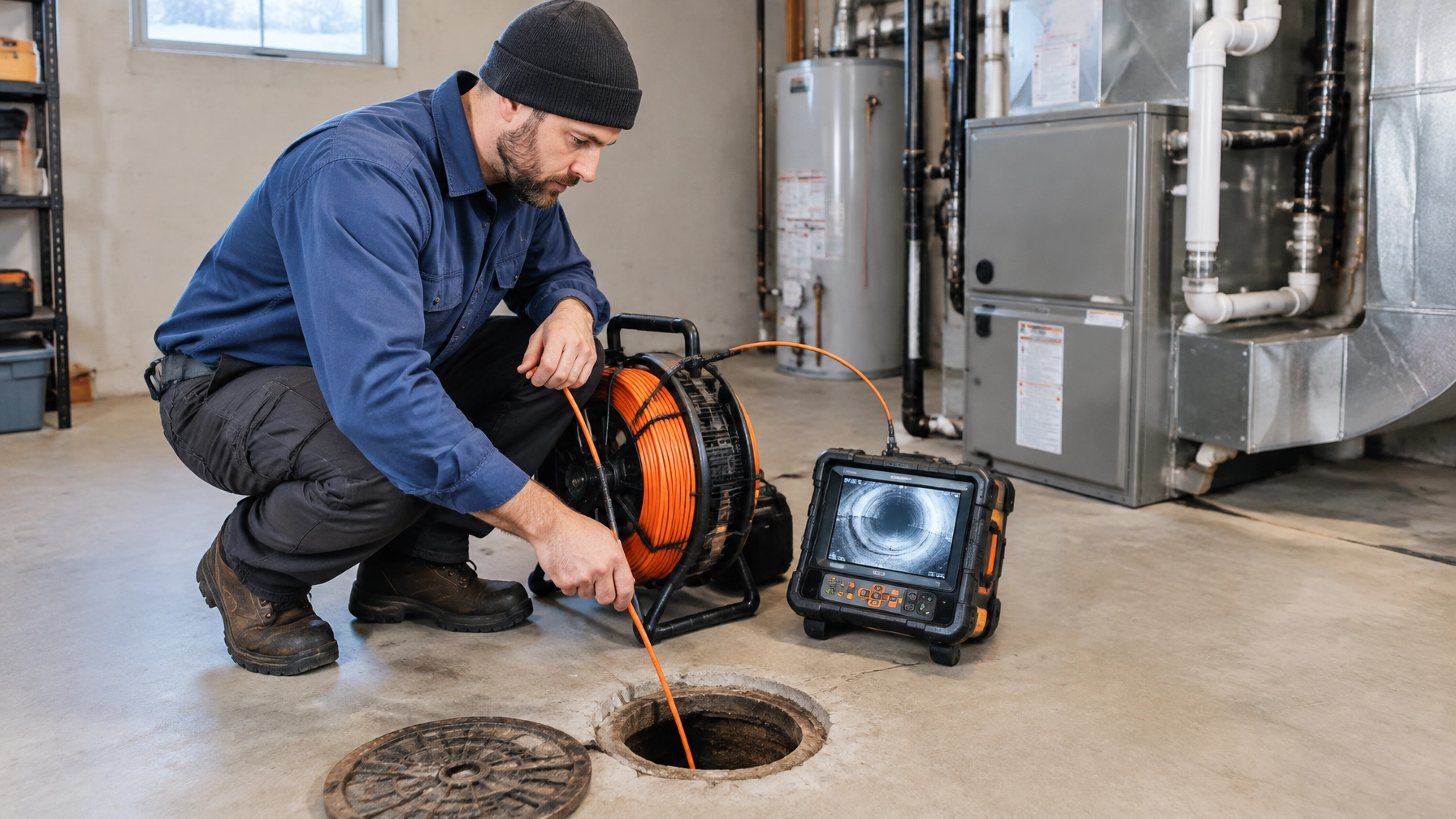
Can you get a sewer scope inspection in Edmonton in winter? Yes. The camera reads the pipe interior regardless of outside temperature. The practical obstacles are access to buried or frozen cleanouts, snow cover and scheduling; excavation for repairs can also be slower and costlier in frozen ground.
I’m Banti K Shaw, an InterNACHI-certified inspector with more than 10 years of inspection and construction experience. I’ve scoped sewer lines in every season, and winter tends to change the access conditions, not what the camera is designed to examine. Here’s what Edmonton homeowners and buyers should know before the spring thaw.
Could a winter inspection tell you something useful before the spring thaw? Yes. A sewer scope shows the visible interior condition of the accessible line on the day of inspection. Cold weather doesn’t make that view less useful, though it also doesn’t predict how the pipe will perform later.
Frost heave and soil movement can put stress on shallow or already sagging sections of a lateral. A scope in late fall or winter may reveal a concern before it becomes an urgent backup. It’s a snapshot, not a promise that the line will remain trouble-free.
If you can, book before the deep freeze. That may make exterior cleanouts easier to find and prepare, and it gives you more time to consider next steps if the camera reveals a concern. You can add a sewer scope to your Edmonton home inspection or read our winter home inspection guide for other seasonal access issues.
“I’ve scoped lines in every season. In winter, I pay close attention to whether we can reach the cleanout safely and clearly explain exactly how much of the line the camera inspected.”- Banti K Shaw
What if the cleanout is outside and covered in snow? Snow can hide its location, while a cap may be frozen in place. Even without snow, an older cap can be seized or fragile. Never force it. Breaking the cap can create a real repair problem.
An interior cleanout in a basement or mechanical room is often the usual winter-friendly access point. Before the appointment, buyers can ask the seller or listing agent where the cleanout is and request that snow, ice and stored items be cleared from the area.

If the cleanout can’t be located or opened safely, the limitation should be documented in the report and the scope may need to be rescheduled. There isn’t always a safe or suitable alternative access point.
Pro tip: Confirm access before the inspection appointment rather than assuming the camera can be inserted through any convenient drain or fixture.
Why does the pipe material matter as much as what the camera sees? Because knowing what the line is made of helps you understand its context and what questions to ask next.
According to EPCOR’s guidance on no-corrode pipe, Edmonton builders used Orangeburg, also called no-corrode pipe, from the 1940s through the 1960s. It is a bituminized-fibre pipe made from wood pulp and tar pitch. EPCOR gives an average life of around 50 years under ideal conditions. As it absorbs water and softens, soil pressure can make it go oval; further deterioration can cause buckling.
Vitrified clay laterals are also found in older areas. Clay is brittle, and on lots with mature trees, roots may enter at pipe joints.
A scope typically helps identify the lateral’s material, which can be half the value of the inspection on a property built from the 1950s through the 1970s. For a closer look at what a camera finds and what it typically costs, see our breakdown of what a sewer scope inspection in Edmonton reveals. Identification is not guaranteed: the InterNACHI Sewer Scope Standards of Practice says inspectors are not required to identify Orangeburg or certain other specific materials. Ask what the report can confirm and what remains uncertain.
If a defect appears near the property line, who handles that section? EPCOR states that the homeowner is responsible for the sewer pipe from the house to the property line. EPCOR also says it does not do replacement work on private property. If a scope identifies a concern, confirm its location and responsibility with the appropriate party before deciding what to do.
What should you expect the scope to document? Under InterNACHI’s standards, a sewer scope runs the lateral from the house at or near the foundation to the municipal tap or septic tank, where accessible. The report should define which portions were inspected and note areas that could not be examined.
Reportable conditions include visible cracks, root intrusion, offsets over ¼ inch, standing water over 1 inch, blockages or restrictions, crushed, broken, separated or collapsed pipe, excessive rust or scale, excessive grease, deteriorated concrete, an egg-shaped line, and delamination or deterioration.
A sewer scope is not technically exhaustive. It does not find concealed defects, locate or mark defects, provide repair-cost estimates, determine remaining pipe life, or inspect under-floor in-house plumbing. It reflects observations made on the inspection date only. For more on how a scope fits into purchase due diligence, see our pre-purchase inspection service.

Could a change in your drains be an early clue? It could. These symptoms don’t identify one definite cause, but they’re worth taking seriously and discussing with a qualified professional:
“A smell or slow drain doesn’t tell you exactly what’s happening underground. I look at the symptoms as useful clues, then rely on the available inspection evidence rather than guessing at the cause.”- Banti K Shaw
Does missing the pre-possession window mean you have no next step? No, but it does mean you may be taking on uncertainty. Consider these practical steps:
A scope performed later can still provide useful information about the line on that day, but it cannot tell you what the camera would have shown before possession.
A few small steps now can make winter access easier. Use this checklist:
Want to understand the line before or after winter access becomes difficult? You can contact InspecUs to ask about adding a sewer scope to a home inspection. Our reports cover 100+ items, are delivered the same day or within 24 hours, and include high-resolution images. InspecUs has 250+ positive Google reviews. There’s no pressure, just a chance to discuss access and timing for your property.
Meta description: Sewer scope inspection Edmonton in winter: frozen cleanouts, Orangeburg and clay laterals, and what a camera can and cannot show before the spring thaw in 2026.
We are licensed by the Licensed Professional and certified through InterNACHI

InspecUs Home Inspection is certified in the best practices established by Internachi. Our commitment to safety includes maintaining a 6-foot distance and using personal protective equipment (PPE) during all inspections.

© 2024 InspecUs - All Rights Reserved. | Sitemap | Developed by Integrated Marketing Platform Inc.