 7132 178 St NW,
 Call us:


 Call us780-809-1056
- Mail usinfo@inspecus.ca
- Schedule An Inspection
Call us780-809-1056

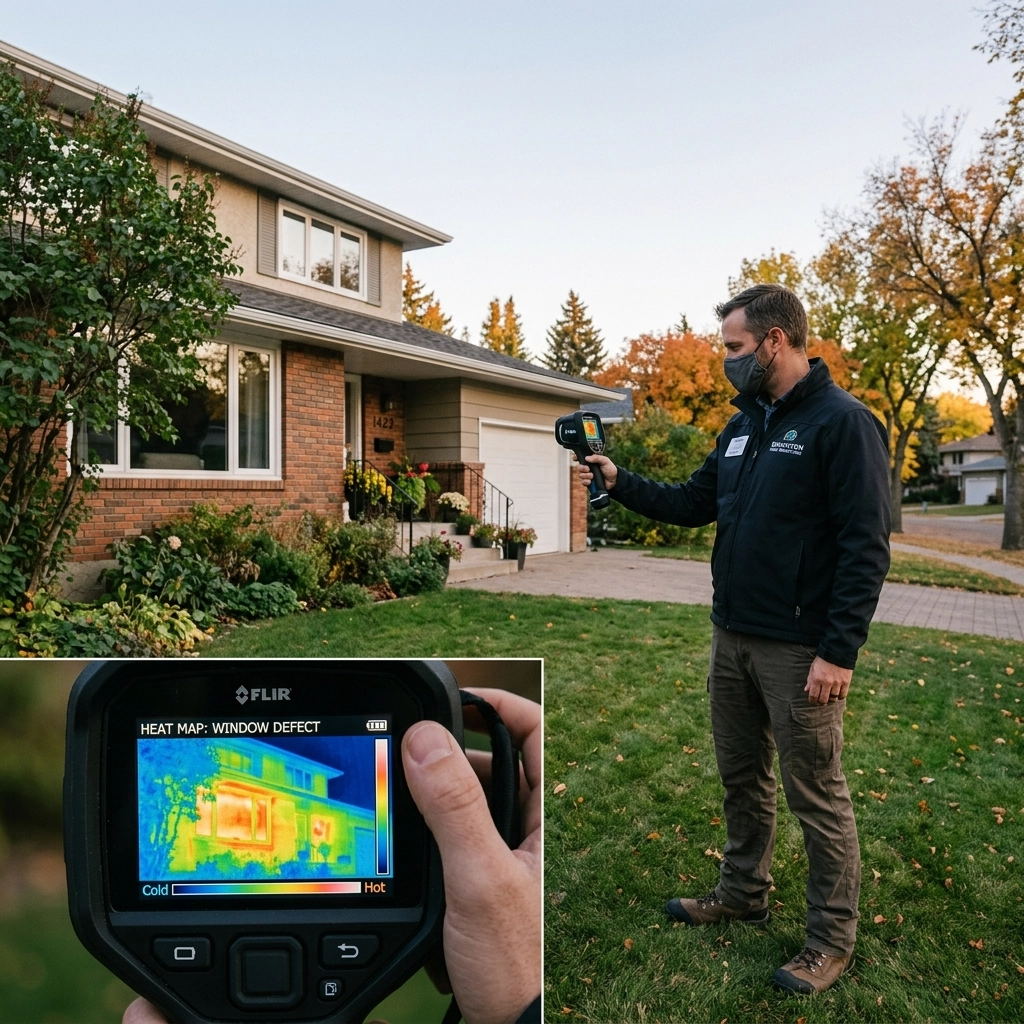
Are you currently house hunting in Edmonton? If so, you’ve probably spent your weekends walking through beautiful properties, admiring modern kitchens and freshly painted walls. But here’s the thing: a fresh coat of paint can hide a world of trouble.
When you’re making the biggest investment of your life, you need to know what’s happening behind those walls. In our years of experience, having performed thousands of inspections across Alberta, we’ve learned that what you can’t see is often more important than what you can.
That’s where thermal imaging comes in. At InspecUs, we don’t just walk through a house with a flashlight and a clipboard; we use high-resolution infrared technology to "see" the thermal signature of the home. For a comprehensive home inspection Edmonton Alberta, this isn't just a "nice-to-have" feature, it’s a deal-breaker.
Let’s break down why this tech is your best friend during a pre-purchase inspection.
Think of a thermal camera as a tool that translates heat into a visual map. Every object emits infrared radiation (heat). Our specialized cameras pick up these heat signatures and display them as a spectrum of colors.
In a typical home inspection, we’re looking for anomalies. If a wall is a consistent temperature except for one cold, dark blue patch, we know something is wrong. That "something" is usually moisture, missing insulation, or an air leak. It’s a non-invasive way to diagnose a house without poking holes in the drywall.

In Edmonton’s climate, moisture is the enemy. Between the heavy summer storms and the spring thaw (when all that snow on your roof starts to melt), water finds its way into the smallest cracks.
The problem? By the time you see a water stain on your ceiling, the damage is already done. Mold has likely started to grow, and the structural wood might be rotting.
How we use it:
Water has a high thermal mass, meaning it holds temperature differently than wood or drywall. Even if a wall feels dry to the touch, our thermal cameras can detect the "evaporative cooling" effect. A dark, plume-like shape on our screen tells us exactly where a leak is hidden. Whether it's a slow leak from an upstairs shower or a failing roof membrane, we catch it before it becomes a multi-thousand-dollar mold remediation project.
Our team at InspecUs regularly finds moisture intrusion that would be impossible to spot otherwise. This is a core part of our thermal imaging and moisture detection services.
We don’t need to tell you that Edmonton winters are brutal. When it’s -30°C outside, your home’s insulation is the only thing standing between you and a massive utility bill.
Construction mistakes happen. Sometimes a builder misses a cavity in the wall, or over time, blown-in insulation settles, leaving the top foot of your walls completely uninsulated. Without thermal imaging, you’d never know, you’d just wonder why that one bedroom is always freezing.
What we watch for:
During a pre-purchase home inspection, we scan the exterior walls and ceilings. Missing insulation shows up as bright "hot spots" (in the summer) or cold "purple streaks" (in the winter).
Pro Tip: Thermal imaging is most effective when there is a significant temperature difference between the inside and outside of the home (at least 10°C). This is why Edmonton’s climate actually makes our thermal scans even more accurate during the winter months!

Electrical fires are a homeowner’s worst nightmare. Many older homes in Edmonton have been renovated, sometimes by DIYers who didn't follow code, or they may still have outdated aluminum wiring.
Standard inspections involve testing outlets, but we can't see the wiring inside the walls. However, an overloaded circuit or a loose connection generates heat.
How it helps you:
By scanning the electrical panel and visible junction boxes, we can see if any breakers or wires are "running hot." A bright yellow or white glow on our camera indicates an electrical circuit that is drawing too much power or failing. Identifying these hotspots allows you to bring in an electrician to fix a fire hazard before you move your family in.
Alberta’s freeze-thaw cycle is particularly hard on buildings. The constant expansion and contraction of materials can lead to seal failures in windows and cracks in building envelopes.
At InspecUs, we believe a report should be more than just a list of problems; it should be a roadmap for your investment.
When we find an issue using infrared technology, we include the thermal image alongside a standard photo in your report. This provides "proof" that is hard to argue with.
Our reports are delivered the same day, featuring high-resolution images that make it easy to understand exactly what’s going on. You can see examples of how we document these findings in our latest insights.

Surprisingly, no. While many inspectors claim to offer "comprehensive" services, many still rely purely on visual checks. At InspecUs, we consider thermal imaging a standard part of our high-level toolkit. Our inspectors are certified and trained to interpret these images correctly: because a camera is only as good as the person reading the data.
"We've seen countless instances where a home looked 'move-in ready' on the surface, but the infrared scan revealed a hidden world of deferred maintenance," says Banti K Shaw from our marketing team. "Our goal is to ensure you never have that 'buyer's remorse' six months after closing."
If you are currently looking for a home inspection Edmonton Alberta, here is your checklist:
Buying a home is stressful enough. You shouldn't have to worry about what’s lurking behind the paint. Thermal imaging takes the guesswork out of the process, giving you a clear, data-driven look at the home’s health.
Ready to see the unseen? Our team is ready to help you make your next move with total confidence.
Book your inspection with InspecUs today and get the full picture of your future home.
We are licensed by the Licensed Professional and certified through InterNACHI

InspecUs Home Inspection is certified in the best practices established by Internachi. Our commitment to safety includes maintaining a 6-foot distance and using personal protective equipment (PPE) during all inspections.

© 2024 InspecUs - All Rights Reserved. | Sitemap | Developed by Integrated Marketing Platform Inc.