 7132 178 St NW,
 Call us:


 Call us780-809-1056
- Mail usinfo@inspecus.ca
- Schedule An Inspection
Call us780-809-1056

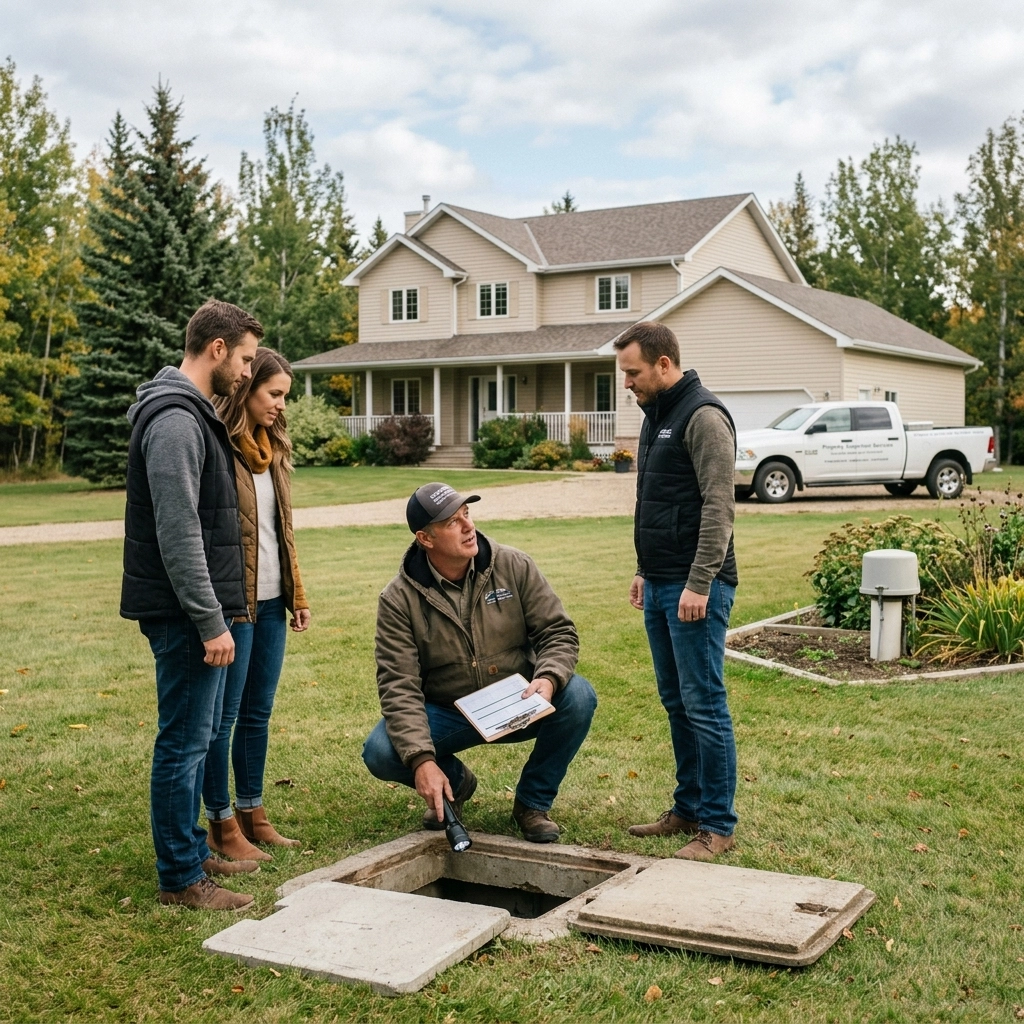
So, you’ve finally found it, that perfect piece of land just outside Edmonton where the air is fresh, the neighbors are at a respectful distance, and you finally have room for that oversized shop. Buying an acreage is an exciting milestone, but it’s a completely different ballgame than buying a bungalow in Bonnie Doon.
When you move out of the city limits, you’re no longer just a homeowner; you’re essentially the manager of your own mini-utility company. You are responsible for your own water and your own waste. If those systems fail, you aren't just looking at a minor inconvenience; you’re looking at potentially tens of thousands of dollars in repairs.
At InspecUs, we’ve spent over a decade walking through properties in Spruce Grove, Leduc, Sherwood Park, and Parkland County. We’ve seen the good, the bad, and the "how is this still working?" of rural infrastructure.
Before you sign on the dotted line, here are 10 things you absolutely need to know about septic and wells when looking for an acreage home inspector in Edmonton.
Most standard home inspectors will look at the house and perhaps "check" the septic by flushing a few toilets. That tells you next to nothing. An expert acreage inspection involves understanding the mechanics of the pump, the integrity of the tank, and the health of the drainage field.
"We regularly find that buyers assume if the water runs, the well is fine," says Banti K Shaw, our marketing lead and property expert. "But 'running water' doesn't tell you if the well will go dry after a 20-minute shower or if the septic field is currently oversaturated and on the verge of total failure."
In Edmonton and surrounding rural areas, well depth and water flow vary wildly. A well flow test (or recovery test) measures how many gallons per minute (GPM) the well can produce over a sustained period.
If a well only produces 1–2 GPM, you might find yourself running out of water halfway through doing the laundry if the dishwasher is also running. We check to ensure the system can handle the demands of a modern family, not just a single faucet.
Edmonton’s "Black Malm" and heavy clay soils are great for farming but can be tricky for septic drainage. If a septic field was poorly designed or if the soil has become compacted, the effluent (liquid waste) won’t soak away.
When we perform an acreage inspection, we look for "spongy" spots in the yard or unusually lush, green grass over the field: both are major red flags that the system is surfacing because it has nowhere else to go.

Just because the water looks clear doesn't mean it’s safe. Alberta’s groundwater can contain high levels of iron, manganese, and: more dangerously: arsenic or nitrates from local agricultural runoff.
Moreover, bacteria like E. coli or Coliforms can seep into wells if the casing is cracked or the cap isn't sealed properly. We always recommend a comprehensive potability test. It’s about more than just taste; it’s about your family’s health.
If the acreage you’re eyeing has a septic mound (an elevated hill in the yard), pay close attention. Mounds are often installed where the water table is high or the soil is poor. They are effective but significantly more expensive to repair or replace than a traditional gravity-fed field.
If we detect issues with the pump or the distribution lines within that mound, you could be looking at a $20,000 to $30,000 replacement bill. You want to know that before you buy, not six months later.
When you’re looking at an acreage, ask for the septic pumping records. A well-maintained tank should be pumped every 2–3 years, depending on the family size. If the current owners can’t remember the last time it was serviced, that’s a sign that sludge may have migrated into the drainage field, which is the leading cause of system "death."
Even on an acreage, the line from the house to the septic tank can fail. Tree roots, shifting soil, or "bellies" in the pipe can cause backups. Because rural lines are often longer than city lines, the risk is higher.
We highly recommend a sewer scope inspection to ensure the main line is clear of obstructions. It’s a small investment that prevents a very messy (and smelly) surprise on move-in day.

Our cold winters are brutal on rural plumbing. If a well line isn't buried deep enough (usually at least 8 feet in our region) or if the "pitless adapter" is failing, your water supply can freeze solid in January.
Our team uses thermal imaging and moisture detection where possible to look for anomalies and ensure your systems are built to withstand the -30°C reality of Alberta winters.
In some areas around Edmonton, groundwater is either unavailable or of such poor quality that the home uses a cistern (a large underground storage tank).
If the property has a cistern, your inspection needs to focus on the tank's integrity and the delivery system. You’ll also need to factor in the ongoing cost of having water hauled to your property. We help you understand the practical day-to-day differences so there are no surprises in your monthly budget.
Not all inspectors are created equal. For something as complex as an acreage, you need someone who is InterNACHI certified. This ensures your inspector has undergone specific training for private water and waste systems.
At InspecUs, we combine that world-class certification with over 10 years of local experience. We don't just give you a checklist; we give you a detailed, same-day report with high-resolution photos and a walkthrough so you understand exactly what you're buying.

Buying an acreage is about freedom, but that freedom comes with responsibility. If the well is dry or the septic is failed, your "dream home" becomes a nightmare very quickly.
Here’s the thing: A standard home inspection might catch a leaky faucet, but it won't tell you if the septic field is at the end of its life. You need a team that knows rural Alberta properties inside and out.
At InspecUs, we take the guesswork out of the process. We’ve inspected thousands of properties, and we treat every acreage inspection as if our own family was moving in. We provide the clarity you need to negotiate fairly or walk away if the risks are too high.
Before you buy, ensure the septic system meets current Alberta Private Sewage Systems Standard of Practice. For example, a septic field usually needs to be at least 15 meters from a dwelling and 90 meters from a water source in certain conditions. If a previous owner did a "DIY" expansion, it might not be legal, which could cause massive headaches if you ever try to renovate or resell.
Don't leave your rural investment to chance. Whether you're in the early stages of house hunting or you’ve just put in an offer, our team is ready to help. We offer certified home inspections that cover everything from the roof shingles to the bottom of the septic tank.
Why choose InspecUs?
Let’s make sure your move to the country is as smooth as possible.
Click here to send us a message or learn more about our services.
We are licensed by the Licensed Professional and certified through InterNACHI

InspecUs Home Inspection is certified in the best practices established by Internachi. Our commitment to safety includes maintaining a 6-foot distance and using personal protective equipment (PPE) during all inspections.

© 2024 InspecUs - All Rights Reserved. | Sitemap | Developed by Integrated Marketing Platform Inc.